Pre-Transaction Wealth Planning for Business Owners
By Kim Kamin, JD, AEP® (Distinguished), Partner & Chief Wealth Strategist
Since its founding, Gresham Partners has worked with many business owners following the sale of their closely held business. The successful sale of a business should be cause for celebration, but some former business owners have been caught off guard by feelings of regret over the process and other emotional reactions to the sale. Some have been surprised to learn after the sale that they could have avoided certain tax costs had they implemented advance wealth planning strategies prior to the sale. These experiences highlight the importance of pre-transaction wealth planning for business owners. Even in situations where an owner is not currently considering a sale, thoughtful planning now can ensure that the owner and the family are properly prepared for the process and have in place a plan that will achieve their long-term objectives.
Navigating Non-Financial Issues
For successful business owners, their companies represent their life’s work and their family’s livelihood and therefore can be much more than a financial asset. Such owners typically have strong emotional ties to their companies and selling the business can be a bittersweet event. Having decided to sell, owners need to consider numerous non-financial questions. For example, they may ask themselves whether they want to stay involved in the business, what they will do with their time following the sale, and how the sale might impact their family.
This last question can be difficult if other family members wish to continue working in leadership roles in the business, which may not be an option once the company is sold. Even if the owner’s family isn’t interested in working in the business, the owner may have concerns about employees and how they will be impacted by the sale.
Other conflicts can arise when the owners’ children or grandchildren have unfounded expectations about how the proceeds from a sale may benefit them personally. If owners have never discussed wealth transfer goals with the family, descendants may have assumptions or beliefs that differ dramatically from the owners’ views on the amounts or timing of any wealth transfers. This issue can be especially sensitive if the owners intend to divide assets unequally among children. For example, some children may be more financially successful and the owners may feel they don’t need additional assets, or the owners may intend to leave the majority of their wealth to charity and haven’t discussed this plan with family.
These types of emotional issues require careful handling to ensure that the sale itself doesn’t cause family discord. In addition, the owners should have an idea of how they intend to spend time after the transaction closes. A wealth advisor can assist the owners and the family in thinking through these issues and, when appropriate, bring in experts to help navigate family dynamics and the psychological aspects of selling a business.
Transferring Business Interests for Wealth Transfer Tax Planning
The federal government imposes a tax on transfers during life (the gift tax) or at death (the estate tax) to individuals or trusts for their benefit. The federal government also imposes a second layer of gift or estate tax, the generation-skipping transfer (GST) tax, on transfers that skip a generation, such as transfers that go to grandchildren or to a trust where that generation is included as a beneficiary. Collectively, these taxes are referred to as “transfer” taxes.
The current federal transfer tax rate is 40 percent. In 2026, the first $15 million of assets transferred by a donor is exempt from this taxation; this amount will be indexed annually for future inflation. In situations where both the federal estate/gift and GST taxes are applicable, the combined rate would be 64 percent. Additionally, several states impose their own transfer taxes on transfers of wealth to descendants or other beneficiaries that aren’t recognized charities. Proposals to change rates and exemption amounts are ongoing, and any planning must reflect current thinking regarding the prospects for such changes.
Transfer taxes arguably constitute a deliberate social policy to prevent the accumulation of inherited wealth by operating in a confiscatory manner over successive generations. Viewed another way, estate taxes are the trade-off for getting a step up in basis at death. But the long-term capital gains tax rate is only 20 percent on the gain from the sale of the business, and estate taxes are 40 percent on the whole fair market value of any business interests, or net proceeds following sale, that the owner has in a taxable estate at death (after applying any remaining exemptions). This makes transfer tax planning paramount, even before thinking about income tax planning.
For business owners who want to minimize the impact of transfer taxes and maximize the amount of wealth passed to their children and more remote descendants, planning early in the sales process is vital. As the value of a business increases, it becomes more expensive from a tax perspective to transfer wealth to future generations. Once a business owner has achieved financial security and is comfortable transferring assets to others, planning for as many years as possible in advance of a potential sale is ideal to move future appreciation out of the owner’s estate. Generally, the sooner planning is done, the better.
Several techniques can be used to shift future appreciation to subsequent generations and produce meaningful transfer tax savings. The two most common of these techniques are (1) making GST tax-exempt gifts into a grantor trust, and (2) a sale of additional interests to freeze the value of the assets before they appreciate.
Gifting to a GST-Exempt Dynasty Trust
Transferring business interests to one or more trusts that benefit a spouse and children can produce significant estate tax savings for the family, but GST planning allows the owner to transfer value to more remote descendants, such as grandchildren and great-grandchildren, and to avoid transfer tax at each generation. Such trusts are even more powerful when they are located in a state that permits perpetual or dynasty trusts, allowing the assets to remain in trust for future generations indefinitely. By leveraging an owner’s gift and GST exemptions to create and fund a dynasty trust, the gifted business interests and their future appreciation can be exempt from estate taxation in both the owner’s estate and in the beneficiaries’ future estates. Further, such trusts are designed to be grantor trusts so the business owner will pay the income tax on all income, including capital gains, generated by the trust’s assets.
Figure 1 illustrates the benefits a business owner can achieve under the following hypothetical facts: (1) a business valued today at $15 million is transferred to a GST-exempt dynasty trust that is a grantor trust; (2) the business is sold in five years for $25 million; (3) after the sale, assets continue to grow at a rate of 5 percent after any spending with the grantor paying all income taxes; and (4) assets in the trust aren’t subject to estate tax at the death of the business owner or beneficiaries of the dynasty trust.
Figure 1: Benefit of Gifting $15 Million Business to GST-Exempt Dynasty Trust
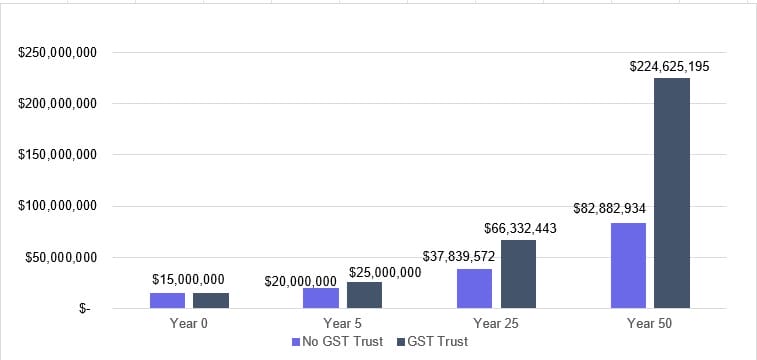
Scenario as of 2026: A business with zero basis valued at $15 million is transferred to a GST-exempt grantor trust. After five years, the business is sold for $25 million, and the grantor pays the 20 percent capital gains tax due on the gain from the sale, allowing the trust assets to grow without a tax drag. The assets appreciate at 5 percent each year after any spending. The grantor continues to pay all income taxes. The final values assume that assets not in the GST trust would be subject to 40-percent estate tax both at the grantor’s death in 25 years and again at the grantor’s sole child’s death, assuming that happens in 50 years. This is just an example; other factors can affect the outcome.
Source: Gresham Partners
Without the strategy described above, at the business owner’s death the assets would be subject to estate tax, which is assumed to be 40 percent on any assets exceeding the exemption shown in figure 1. As shown, this dynasty trust strategy can produce substantial increases in the value of assets available for future generations. During a 50-year period, 2.7 times more assets can be available for the business owner’s descendants.
In addition to producing a larger pool of assets for grandchildren and remote descendants, this dynasty trust strategy also can permit the business owner’s spouse or children to draw upon assets in the trust if they need to do so because the trust can be designed as a spousal lifetime access trust (SLAT) with the spouse and children as current beneficiaries too. This combination of shifting asset values to future generations without transfer tax costs, while keeping the assets available for use by current or earlier generations, makes this strategy incredibly attractive.
Freezing Value by Selling Business Ownership Interests to the Dynasty Trust
After fully utilizing the $15-million exemption, owners may, depending on their financial needs, desires, and the value of their remaining business interests, wish to freeze the value of those remaining interests in their estates by selling them to the dynasty trust in exchange for a promissory note payable over time at the applicable federal rate (AFR). It can be structured as an interest-only note that can be paid down using distributions from the business, and, if the lump-sum principal payment is due before the business is sold, it can be renegotiated or repaid using the business interests in kind.
The sale amount generally can be up to nine or 10 times the value of the assets already in the dynasty trust and advisors will still be comfortable that the trust is creditworthy for the purchase. For example, if the dynasty trust is funded with $15 million, most attorneys and tax advisors would be comfortable with the owner selling up to $135 million to the trust. This strategy allows the owners to transfer the future potential appreciation in the transferred business interest. The freeze/sale approach also can be an option for a business owner who can’t comfortably afford to give away the full $15 million because with the sale they are transferring only the future appreciation and locking in their right to the current value in the business (plus interest).
Alternatively, a business owner could use a grantor retained annuity trust (GRAT) to freeze the value of their interest in the business, but (1) this strategy is limited to transfers to children because a GRAT can’t be GST exempt, (2) the applicable interest rate (the Section 7520 rate) may be higher, because it is set at 120 percent of the mid-term AFR rounded even, and (3) because the GRAT can’t be interest only, the annual annuity payments almost certainly will need to be paid back with business interests until such time as the business is sold, necessitating annual qualified appraisals during the GRAT term. Therefore, the installment sale to a dynasty trust typically is the preferred approach for an appreciating business.
Importance of Current Contingency Planning
Even before a business owner feels financially secure and ready to transfer assets, other types of pre-transaction planning are important. A business is an illiquid asset often constituting most of the family’s wealth.
First, business owners should maintain adequate life insurance to protect against a forced liquidation of the business at death. If a business has multiple owners, buy–sell agreements should be in place to ensure there is a succession plan and sufficient liquidity for the deceased owner’s share of the company. Additionally, business owners should examine their personal liability coverages and assess whether to purchase excess liability (umbrella) coverage to ensure they have adequate liability protection from potential creditors in the event of a lawsuit.
Moreover, the owner’s estate planning instruments should be reviewed and updated periodically. As the business value increases over time, the desired terms of the plan can evolve, and both transfer taxes and asset protection need to be considered against contingencies that could force a liquidation of the business interests.
Assuming the owner’s closely held business interest will pass in trust upon the owner’s death, typically there should be a special trustee experienced in dealing with private companies in the same industry, because this may represent a primary or significant asset in the trust. If the trustees aren’t comfortable as fiduciaries continuing to hold the private business interest in the trust, they may try to liquidate this interest or even attempt to force a sale of the entire company in an effort to diversify the trust’s assets. Further, without proper advisors or guidance from an experienced business leader familiar with the industry, the trustees may not extract maximum value in the sale.
Planning to Minimize Income Taxes from Sale
Even if substantial interests in the business have been transferred successfully to a grantor trust during the owner’s life, it will still be desirable to minimize the capital gains from a sale. There are a number of strategies for doing so. Primary options include: (1) taking advantage of qualified small business planning under IRC Section 1202 to avoid capital gains tax, (2) generating losses in a portfolio to offset the gains from selling the business, and (3) charitable planning strategies to offset gains. The charitable planning strategies also can offset transfer taxes.
Taking Advantage of QSBS Benefits
If the business interests are qualified small business stock (QSBS) at the time of sale, then the application of IRC Section 1202 can shelter significant amounts of gain from income tax. IRC Section 1202 allows taxpayers to exclude the greater of $15 million of gain or 10 times their basis from federal income tax, subject to certain requirements. To qualify, the stock must (1) be originally issued by a C corporation; (2) at the time of issuance, the company must have had aggregate gross assets of less than $50 million if issued before July 4, 2025, or $75 million if issued after that date; and (3) be used in the active conduct of one or more qualified trades or businesses. Banking, insurance, farming, most hospitality businesses, and certain service businesses in health, law, engineering, architecture, accounting, and financial services are excluded from the definition of a qualified trade or business.
A business owner who holds QSBS can gift the stock to a grantor trust such as the dynasty trust described above, but a grantor trust isn’t a separate taxpayer, so it won’t get its own QSBS benefits. The business owner, however, can multiply QSBS benefits by gifting QSBS to irrevocable trusts for descendants or others as long as each trust also is for different beneficiaries with differing terms and the trusts aren’t created solely for tax avoidance. Each of these non-grantor trusts, plus the business owner or dynasty trust, can then exclude the greater of $15 million or 10 times the basis from federal income tax upon the sale of the business. This strategy is referred to as stacking.
Tax-Loss-Generating Strategies
Tax-loss generation is a powerful strategy that can be used to offset capital gains generated from the sale of a business via tax-loss harvesting. A business owner who anticipates a liquidity event can begin planning to leverage these strategies to reduce the tax hit from the sale. For example, consider a business owner who might intend to sell a business for $50 million in two to three years. The business owner could invest $10 million of other assets in a tax-loss harvesting strategy. When the business sells, the owner can offset the resulting long-term capital gains with the losses generated by the strategy, even using unused losses that carry over from prior years.
If the business owner doesn’t have funds to invest before the liquidity event, selling the business as early in the calendar year as possible would provide time to invest the proceeds in a tax-loss-harvesting strategy and generate tax losses in the same year. Though time is a necessary resource to maximize this strategy, even a short period of time invested in the strategy can create tax savings because each dollar of capital loss saves approximately 24 cents of federal income tax. For example, a business owner in Chicago who used a tax-loss strategy for the final three months of the year could generate $14,000 in tax savings for each $1 million invested in the strategy. These numbers assume the effective tax rate is a combination of long-term federal (23.8 percent) and Illinois (4.95 percent) capital gains rates.
Charitable Planning Strategies
For business owners who are philanthropically inclined, the sale of a business is an opportune time to consider implementing charitable giving strategies that also can reduce income taxes and, in some cases, transfer taxes as well.
Outright Gifts to a Family Foundation or Donor-Advised Fund
As part of pre-transaction planning, once a sale is imminent, outright gifts to charity in the year of sale can offset gain. Business owners who wish to make outright gifts to a donor-advised fund (DAF) or private foundation should do so in cash or highly appreciated marketable securities to offset their income in the year of the anticipated liquidity event, subject to certain income tax limitations. If the sale is early enough in the year, they can use the sales proceeds for a cash gift. But they will want to plan ahead because it can take time to set up a foundation or DAF.
If planning far enough in advance, before a sale is imminent, a business owner might wish to gift business interests to charity directly. This could be a good idea because it would fully prevent the business owner from realizing capital gains on the sale, which will be only partially offset by a year-of-sale donation. However, a private foundation is subject to the excess business holdings rules, and most DAFs aren’t willing to accept interests in privately owned companies because they are illiquid and generate minimal returns. For such business owners, a supporting organization may be their best option for contributing the business interests.
If a business owner wishes to transfer a portion of a non-publicly traded business to a DAF, the sponsoring organization probably will accept it only if (1) the company’s governing documents permit the assignment, (2) the company will redeem the interests gifted from the DAF, or (3) a sale is contemplated. Even so, business owners must be mindful of the anticipatory assignment of income doctrine, which states that a taxpayer who has earned income will be taxed on it, even if the right to that income is assigned to a third party (including a charity).
As referenced above, business owners generally would not make outright gifts of business interests to their private foundations due to the excess business holdings rules. If a private foundation holds more than a de minimus amount of a private business (more than 2 percent), then it is subject to the limitations prohibiting a foundation from holding more than 20 percent of any business, reduced by the percentage of voting stock actually or constructively owned by disqualified persons (with some limited exceptions).
Gifts to Charitable Remainder Trusts
For some business owners, establishing a charitable remainder trust (CRT) may be a good option. CRTs allow business owners to gift a remainder interest to a charitable entity, such as their DAFs or foundations, while retaining the right for themselves or other desired beneficiaries to receive payments over a lifetime or a term of years. The payments are made as either an annuity or a unitrust calculation. Typically, the unitrust option will be best for an appreciating asset because as the value of the asset goes up, the value paid out to the owner or their family members will be higher. A business owner who anticipates a liquidity event can gift the business to a charitable remainder unitrust (CRUT) and take an immediate income tax deduction for the value of the remainder. CRUTs work best in a high-interest environment because the higher the Section 7520 rate, the lower the noncharitable retained interest and the larger the initial income tax deduction.
If the business isn’t expected to generate enough income to make annual unitrust payments before the sale, the CRUT can instead be structured as a flip CRUT. In this case, the trust can be designed so that the first years wouldn’t require a payout to the noncharitable beneficiary and the payout would begin only once the sale has occurred.
When the liquidity event occurs, a CRUT also will save the business owner from the immediate realization of capital gains. Instead, capital gains will be deferred and paid out incrementally with each annuity or unitrust payment. The CRUT can diversify the portfolio post-sale (which will benefit both charitable and noncharitable beneficiaries) and utilize tax-loss-harvesting strategies to offset the capital gains that pass to the business owner with each annuity or unitrust payment.
Figure 2: Benefit of Transferring $15 Million Business to Flip CRUT
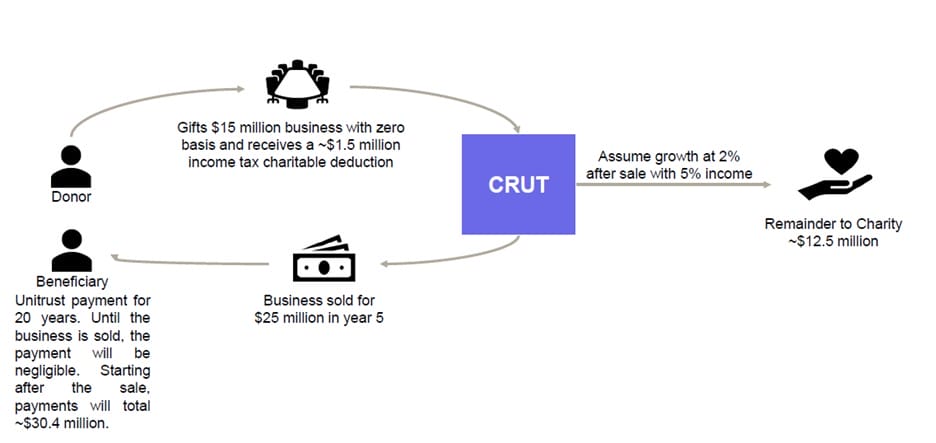
Scenario as of 2026: A business with zero basis valued at $15 million is transferred to a flip-CRUT in March 2026 when the Section 7520 rate is 4.8 percent. The CRUT makes optimized unitrust payments to the business owner for 20 years. For the first five years, growth is 10.75 percent with zero income. The business is sold in year 5 for $25 million. After the sale, if the unitrust payments appreciate at an assumed rate of 5 percent after all income taxes, the noncharitable beneficiary would have nearly $48 million at the end of the 20-year CRUT term. This is just an example; other factors can affect the outcome.
Source: Gresham Partners
Gifts to Charitable Lead Trusts
A business owner might plan to offset gains from a sale by gifting a portion of the proceeds into a charitable lead trust (CLT). A CLT pays an annuity or unitrust amount for a term of years to a charitable beneficiary, such as the client’s DAF or foundation. Then the remainder, if any, passes to noncharitable beneficiaries. Importantly, a CLT can be structured as a grantor or non-grantor trust. If it is a grantor trust, the business owner can take an immediate income tax deduction equal to the value of the assets transferred to the charitable beneficiary. This is commonly done in the year of sale with a zeroed-out charitable lead annuity trust (CLAT) to maximize the charitable deduction. If the business owner wanted to transfer the business interests themselves to the CLAT (within five years of sale to avoid the excess business holding rules), a CLT also can be structured as a “shark fin” CLAT to minimize annuity payments until after the business is sold.
Like the CRT, the CLT is primarily a charitable giving strategy intended for business owners who want to see significant assets pass to charity. That said, the goal is for the asset growth in the CLT to outperform the Section 7520 rate, and the remainder interests will pass to the noncharitable beneficiaries free of transfer tax. For example, if a business owner gifts business interests worth $5 million to a zeroed-out CLAT at the 4.8 percent Section 7520 rate in March 2026, their children as the noncharitable beneficiaries could receive approximately $3.15 million at the end of a 20-year term if the assets grow at 7 percent annually. The lower the 7520 rate, the better the CLAT would perform.
Conclusion
Pre-transaction planning can yield many benefits to a business owner, including: (1) ensuring that the owner’s family is financially protected if some unexpected negative event occurs before a sale; (2) reducing potential family conflicts that may arise as a result of a potential sale; (3) minimizing the impact of future transfer taxes; and (4) reducing the extent of income taxes due upon a sale. Although it is possible to engage in some planning strategies after a transaction has been announced, or even after it has closed, the largest benefits can be achieved by planning before a transaction is even contemplated and before significant appreciation in the business is realized.
It is critically important that business owners think about their long-term goals years before any business sale may occur, consider various strategies that can help them achieve their goals, and then properly implement the chosen strategies. This process is best done with the guidance of an advisor who is in a position to serve in the owner’s best interests, has a complete understanding of the owner’s personal and financial situation, and is experienced with the use of a full range of pre-transaction planning strategies.
IMPORTANT DISCLAIMER: This material is not a comprehensive review of the topics covered. It has been prepared for informational purposes only and is not intended to provide and should not be relied on for tax, legal or accounting advice. Readers should consult their own advisors before engaging in any transaction.